
Polymers for of Oil and Nanoplastic Remediation
- Hollow Amphiphilic NanoDispersants (HANDs) from nanoparticle templates
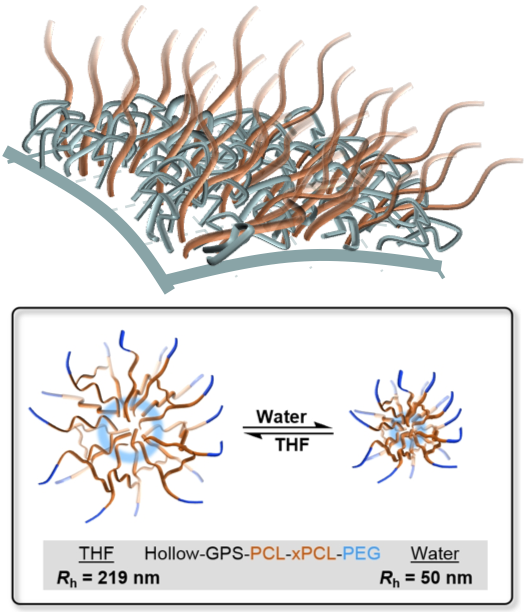
The Deepwater Horizon oil spill demonstrated a key need for the development of environmentally friendly oil dispersants. In collaboration with Grayson (Tulane) we are developing ‘concentration-independent’ dispersants that will not allow sequestered oil to be released in the infinite dilution of the ocean. Unimolecular micelles can be produced using a sacrificial nanoparticle scaffold of silica or lactose to afford hollow amphiphilic nanodispersants (HANDs). In a separate project, we are studying the use of polymers to produce organogels. The goal is to develop a system that is able to convert spilled oil into a gel that can be physically removed from the suface of the water.
- Polymer flocculants to remediate nanoplastics
Micro and nanoplastics pervade every part of the environment. In collaboration with De Hoe (UF MSE), we are studying polymer flocculants for nanoplastics composed of the several major polymer contaminants (e.g., PE, PP, PVC, PS, PET) in wastewater and landfill leachate. The first part of this project involves testing commercial flocculants in laboratory and real aqueous systems. The second part of this project involves developing new polymers for use as chemical flocculating agents. The challenge is that, in contrast to biological contaminants in water, nanoplastics are charge neutral and may take on many different shapes and form factors.

Our principal analytical tools incorporate dynamic light scattering, zeta potential, fluorescence, and SEM.